Game of Thrones: Legends RPG
- 4.5
- Rating
- 1.00M
- Installs
- Free
- Price
 Analysis by App-foxy
I spent time with Game of Thrones: Legends RPG as a mobile puzzle game, and my first impression was that it is trying to serve two audiences at once: people who enjoy quick match-three rounds and fans who want a familiar fantasy setting around those puzzles. That combination gives it more personality than a plain tile-matching game, but it also means the experience is not equally satisfying for everyone. If you want a relaxed puzzle session with recognizable characters and a role-playing layer, it is easy to understand. If you expect a deep strategy RPG or a completely fair, endlessly varied puzzle system, you should approach it more carefully.
The game is free to download and is developed by Zynga. It is rated for Everyone 10+, which fits the fantasy conflict and competitive tone better than a general-audience label would. The store summary presents it as a House of the Dragon and Game of Thrones puzzle RPG, and that identity is important: the setting is not just decoration placed behind a generic board. It is the main reason many players will try the game in the first place.
How the current version feels to play
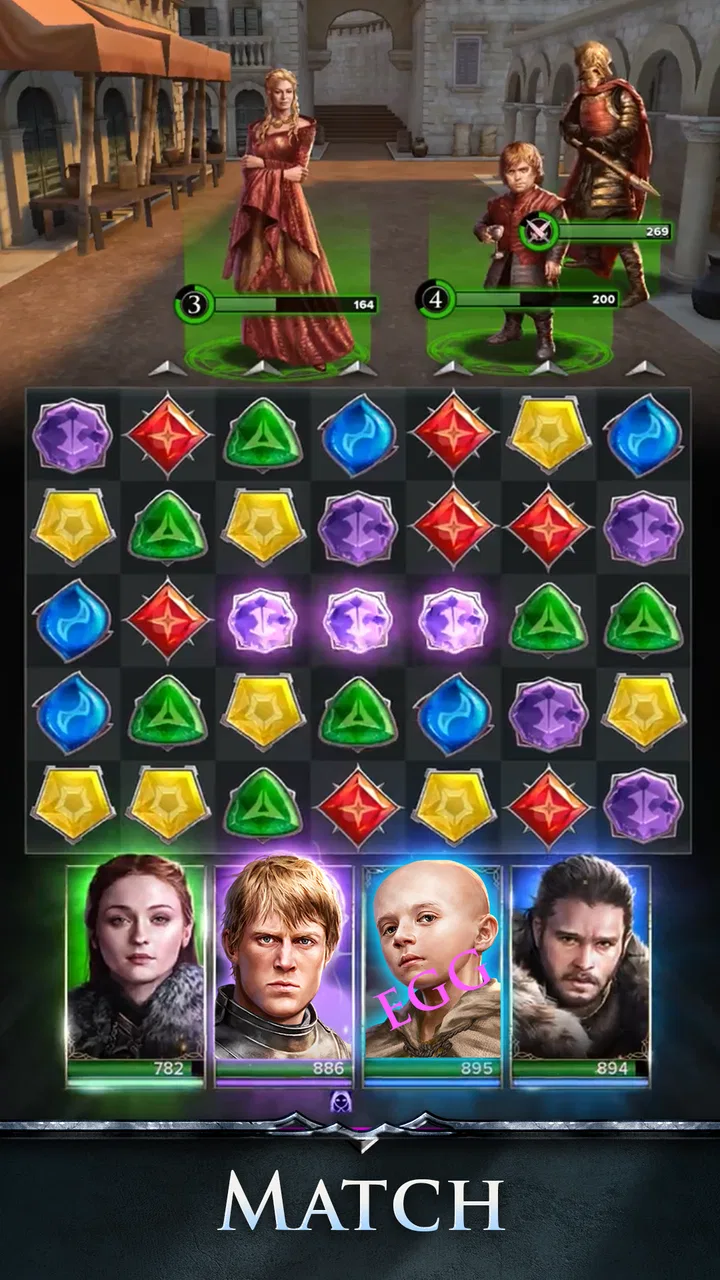
The central loop is straightforward. I enter a stage, make matches on the puzzle board, and use the resulting attacks or effects to deal with opposing characters. The appeal comes from making ordinary matches feel connected to a team battle. A good move is not only about clearing nearby pieces; it is also about thinking ahead, building a stronger turn, and deciding when a useful combination is worth setting up instead of taking the quickest match.
You May Also Like

 Blood Strike: 2.5 Anniversary
Blood Strike’s Loadouts Turn Every Drop Into a Tactical Gamble
A close look at Blood Strike’s custom loadouts: how fast access to signature weapons reshapes its battle royale rhythm, rewards preparation, and narrows the gap between fights.

 Pandora - Music & Podcasts
Pandora’s Music Is Easy to Start, but Harder to Recover
Pandora’s strength is its low-effort path from a seed to a station. Its weak spot is how much confidence it asks you to place in connection, setup, and quiet recovery.

 8 Ball Pool
 Is Built on Rivalries, Rematches, and Routine
A close look at the rivalries, rematches, shared routines, and unanswered safety questions that turn a quick pool match into a persistent mobile community.

 Samsung Music
’s Quiet Strength Is Playing What You Already Own
Its reach comes less from spectacle than from dependable access to a personal library. That simplicity is both the app’s strongest retention engine and its ceiling.

 AccuWeather: Weather Radar
AccuWeather Review: A Quick, Clear Forecast for Everyday Decisions
For everyday plans, the best forecast is the one you can understand quickly. AccuWeather makes rain timing, radar, and local conditions easy to act on, with a few trade-offs.

 Hill Climb Racing
Why Hill Climb Racing Still Turns Crashes Into One More Run
A tiny car, a bumpy hill and one more upgrade: Hill Climb Racing keeps resurfacing because its simple chaos makes every near-miss feel personal.
More From Our News Desk



That makes the game a comfortable choice for short sessions. I can play while waiting for an appointment or fit in a few stages without needing a long uninterrupted block of time. The format is more approachable than a traditional role-playing game because the basic action is familiar immediately. You do not need to learn a complicated control scheme, and the board gives you a clear visual target every time a turn begins.
At the same time, the RPG framing adds a layer of planning that is easy to underestimate. Team selection, character improvement, and the way puzzle actions support combat all affect how a stage feels. The best results do not come only from moving tiles quickly. I found that paying attention to which character benefits from the current board can matter more than making the most obvious match.
The useful habit is to treat every turn as a small resource decision rather than a race. Before moving, I look for matches that can create a better follow-up, not just the first available clear. This is especially helpful when a stage becomes more demanding and a careless move leaves the board in an awkward shape. Players who enjoy planning several moves ahead will get more from the puzzle system than players who simply tap the brightest option.
A familiar world with a different kind of focus
The Game of Thrones setting gives the progression a sense of place. Recognizable names and factions make collecting and improving characters feel more meaningful than upgrading anonymous puzzle pieces. For fans, that connection can turn a routine win into a small story beat: the team on the board feels like a group assembled from the world rather than a collection of interchangeable icons.
Still, the license does not automatically make the game a strong RPG. The role-playing depth is built around the puzzle loop, so anyone hoping for the freedom of a large adventure or the tactical detail of a console role-playing game will find a much narrower experience. I see it as a match-three game with RPG progression, not as a full-scale fantasy RPG that happens to include puzzles.
That distinction helps set expectations. I would recommend it to a fan who wants to interact with the setting in small, repeatable sessions. I would not recommend it as the main choice for someone seeking exploration, lengthy dialogue, or a complex combat system with many manual actions.
What the release and version tell us
The game was released on July 24, 2024, and the current version is 1.0.480. Those details place it in a relatively early stage of its life compared with long-established puzzle RPGs. In practical terms, that makes the current build worth judging on what it already delivers rather than on promises about where it might go.
I also see the version number as a sign that the game has moved beyond its initial launch build through ongoing version changes. That does not prove that every rough edge has been fixed, and it would be a mistake to assume that future updates will solve every concern. It does suggest that the developer is maintaining the product, which matters for a game built around repeat play and long-term progression.
For a new player, the sensible approach is to begin with the current experience and avoid spending money simply because the game may expand later. Early adopters often tolerate more repetition while a title finds its rhythm, whereas someone joining now should ask whether the existing stages, progression, and puzzle variety are already enough for their habits.
How the game handles everyday play
My favorite use case is a short break where I want something more engaging than an idle clicker but less demanding than a competitive action game. A couple of puzzle encounters can provide a clear beginning and end, and the board-based controls suit a phone screen well. I do not need a controller, a quiet room, or a large amount of concentration to understand what is happening.
There is also a useful difference between playing for completion and playing for improvement. If I only want to clear a stage, I can make sensible matches and keep moving. If I want to build a stronger roster, I need to think about upgrades and how my chosen characters work together. That second approach gives the game more staying power, but it also makes the experience feel more like a long-term hobby than a simple casual diversion.
One practical tip is to avoid treating every available upgrade as equally urgent. I prefer to strengthen the characters I actually use instead of spreading resources across a wide roster too early. A broad collection may look attractive, especially for a fan of the franchise, but a focused team is easier to understand and usually makes the progression feel less scattered.
Another useful habit is to pause before replaying a difficult stage. Repeating the same approach can turn a puzzle into a frustrating routine. I get better results when I first consider whether the problem is my board decisions, my team arrangement, or simply a need for more progression. That small distinction prevents wasted attempts and makes the game feel more strategic.
Where the free-to-play model changes the experience
The game is free, but it includes in-app purchases ranging from $0.99 to $349.99 per item. That is a wide range, and it is the main reason I would encourage families and younger players to use purchase controls on the device. The age rating does not remove the need for that conversation, especially when a game encourages continued progression and character improvement.
I can enjoy the basic puzzle loop without paying, but the presence of purchases affects how I evaluate the overall design. Free-to-play games often ask the player to decide whether patience, repetition, or spending is the preferred way to move forward. That choice is not automatically a flaw, yet it becomes frustrating when progress starts to feel less like a puzzle challenge and more like a test of tolerance.
My advice is to set a personal rule before playing. For example, decide that you will only spend if the game remains enjoyable without purchases, rather than paying to rescue a frustrating session. This is particularly important here because the licensed setting can make optional character-related offers feel more tempting than they would in an original game.
Players who dislike energy limits, repeated stages, upgrade pressure, or any form of optional spending should probably choose a premium puzzle game instead. A paid alternative may offer fewer collection incentives and a clearer endpoint. It will not provide the same Game of Thrones connection, but it may be a better match for someone who wants puzzles without a long-term monetized progression structure.
How it compares with other puzzle RPG choices
Compared with a basic match-three game, this title offers a stronger reason to care about the team surrounding the board. The fantasy setting, character collection, and RPG framing give each session more context. A standard puzzle game may be cleaner and more focused on score or level design, but it can also feel less personal once the novelty of matching tiles wears off.
Compared with a deeper role-playing game, this one is much easier to pick up but much less flexible. Traditional RPGs usually offer more control over movement, equipment, exploration, and combat choices. Here, the puzzle board remains the center of attention. That makes it friendlier for casual play, but it limits the kinds of strategies available to players who want detailed control over every battle.
Compared with a purely licensed collection game, the puzzle element gives me something active to do. I am not only opening menus or watching numbers rise; I am making decisions on the board. The trade-off is that the same core loop can become repetitive sooner if the stages do not keep introducing meaningful variations.
This is why I would place the game between casual puzzle entertainment and a light RPG. It is strongest when those two sides support each other. It is weaker when the player expects one side to replace the other completely.
What existing players should know about progression
For someone already playing, the most important question is whether the current version feels like a refinement of the original release or merely a larger version of the same loop. With a release date in 2024 and version 1.0.480 now available, I would look for practical improvements in how smoothly the game presents its progression, how clearly it explains upgrades, and how well new content avoids making earlier effort feel obsolete.
Existing users should also be cautious about changing teams too often. A new character can be exciting, but replacing a familiar lineup repeatedly may leave several partially developed characters and make difficult stages harder than necessary. I prefer to test a new addition in lower-pressure content before committing valuable upgrade materials to it.
Another consideration is device compatibility. The game requires Android 10 or later, so anyone using an older Android phone should check that requirement before planning a download. On supported devices, the board format is naturally suited to touch controls, but the broader question is whether the phone has enough remaining storage and battery comfort for a game intended to be played repeatedly. Those are everyday concerns worth checking before making it a regular habit.
Remaining friction and who should skip it
The biggest limitation is repetition. Match-three combat can be satisfying, but its basic action remains familiar from stage to stage. The RPG layer helps by giving the matches a purpose, yet it cannot completely hide the fact that the player is still making variations of the same kind of move.
There is also a possible tension between fandom and gameplay. A player may download the game because of the world and then discover that the main attraction is still the puzzle board. If the characters and setting are the only things that interest you, the game may not provide enough narrative depth. On the other hand, if you already enjoy match-three systems, the license may be a welcome bonus rather than the entire reason to stay.
I would skip it if I want a one-time purchase with no purchase prompts, a story-heavy adventure, or a highly technical puzzle game where every level is built around a new mechanical idea. I would also skip it if I tend to spend impulsively in collection games. The combination of recognizable characters and optional items can make restraint harder than expected.
I would give it a chance if I enjoy short mobile sessions, like building teams gradually, and appreciate the Game of Thrones setting without needing a full television-style storyline. The game works best when I accept its boundaries instead of asking it to be a different kind of RPG.
What I would watch as the game develops
Future updates will matter most if they add meaningful reasons to return rather than only expanding the number of things to collect. I would watch for puzzle variety, clearer progression choices, and ways for established players to use older characters without feeling that every new addition makes them irrelevant. Those changes would improve the long-term experience more than a simple increase in roster size.
I would also pay attention to how the game balances free progression with its purchase system. A healthy balance lets patient players continue learning and improving while keeping optional spending genuinely optional. If progress becomes increasingly dependent on purchases, the puzzle layer will feel less important, and that would weaken the part of the game that makes it distinctive.
The current version already has a clear identity: a free puzzle RPG built around a major fantasy setting, made by Zynga, and available for Android devices running version 10 or later. It has reached more than one million installs and holds an average rating of 4.5 from roughly thirty-one thousand ratings, which suggests that the concept has found a substantial audience. Those numbers are useful context, but they do not replace personal fit. A popular game can still be wrong for someone who dislikes its progression style.
My recommendation after playing
I came away viewing Game of Thrones: Legends RPG as an approachable licensed puzzle game with enough team-building to keep the matches from feeling empty. Its strongest quality is the way familiar characters give ordinary board decisions a larger purpose. Its weakest point is that the same structure can become repetitive, especially for players who are not interested in long-term roster development.
For a free download, it is worth trying if you want a casual puzzle RPG and already enjoy the world of Westeros or House of the Dragon. Start without spending, focus on a small group of characters, and judge the game by how much you enjoy the basic board loop rather than by the promise of future content. That approach gives you a fair view of what is available now.
My final recommendation is positive but selective: this is a good fit for fans who want quick, touch-friendly battles with a recognizable fantasy theme, not for players searching for a deep standalone RPG or a purchase-free puzzle experience. If that distinction matches what you want from your phone, Zynga’s game can become an enjoyable daily break. If it does not, a simpler premium puzzle game will probably respect your time and expectations better.
FAQs for Game of Thrones: Legends RPG
01What is Game of Thrones: Legends RPG about?
Game of Thrones: Legends RPG is a strategy and role-playing game set in the rich and immersive universe of Westeros. Players can build their own house, forge alliances, and engage in epic battles. The game allows you to interact with iconic characters and make decisions that shape the storyline, offering a unique and personal experience.
02Is Game of Thrones: Legends RPG free to play?
Yes, Game of Thrones: Legends RPG is free to download and play. However, it includes in-app purchases that offer various enhancements and items to improve gameplay. Players can choose to buy these extras, but it is possible to enjoy the game without making any purchases, though it may require more time and effort.
03What are the system requirements for Game of Thrones: Legends RPG?
To ensure smooth gameplay, Game of Thrones: Legends RPG requires a device running Android 6.0 or higher or iOS 11.0 or later. The game also needs at least 2GB of RAM and a stable internet connection, as it frequently updates content and features. Ensure your device meets these requirements for the best experience.
04Can I play Game of Thrones: Legends RPG offline?
No, Game of Thrones: Legends RPG requires an active internet connection to play. The game is designed to be a dynamic and interactive experience, with regular updates and real-time multiplayer interactions. This means that playing offline is not supported, so ensure you have a reliable internet connection.
05How does Game of Thrones: Legends RPG handle player progress and saves?
Game of Thrones: Legends RPG automatically saves your progress to the cloud, ensuring that your game is backed up and accessible across multiple devices. To prevent data loss, it's recommended to connect your game account to a social media account or email. This also allows you to retrieve your progress if you switch devices.
Pros
- Immersive storyline and world-building.
- High-quality graphics and animations.
- Diverse character customization options.
- Strategic gameplay with engaging battles.
- Regular updates with new content.
Cons
- Requires a stable internet connection.
- Can be resource-heavy on older devices.
- In-app purchases can be costly.
- Occasional bugs and glitches.
- Long loading times at startup.

Game of Thrones: Legends RPG
Gallery